
UV Printer Malaysia: Complete Buyer's Guide 2026
A UV printer is suitable for Malaysian print shops, signage makers, and product customisation businesses that want to print directly on materials such as acrylic, PVC board, wood, glass, metal, and promotional items. This guide covers everything you need to know before investing in this technology in 2026.
Key Takeaways
- UV printers cure ink instantly with UV light — prints are waterproof and scratch-resistant immediately
- UV flatbed machines handle rigid materials; roll-to-roll handles flexible media; hybrid handles both
- White ink and varnish capabilities are critical for transparent acrylic and dark surfaces
- Local installation, training, and spare parts support are just as important as the machine price
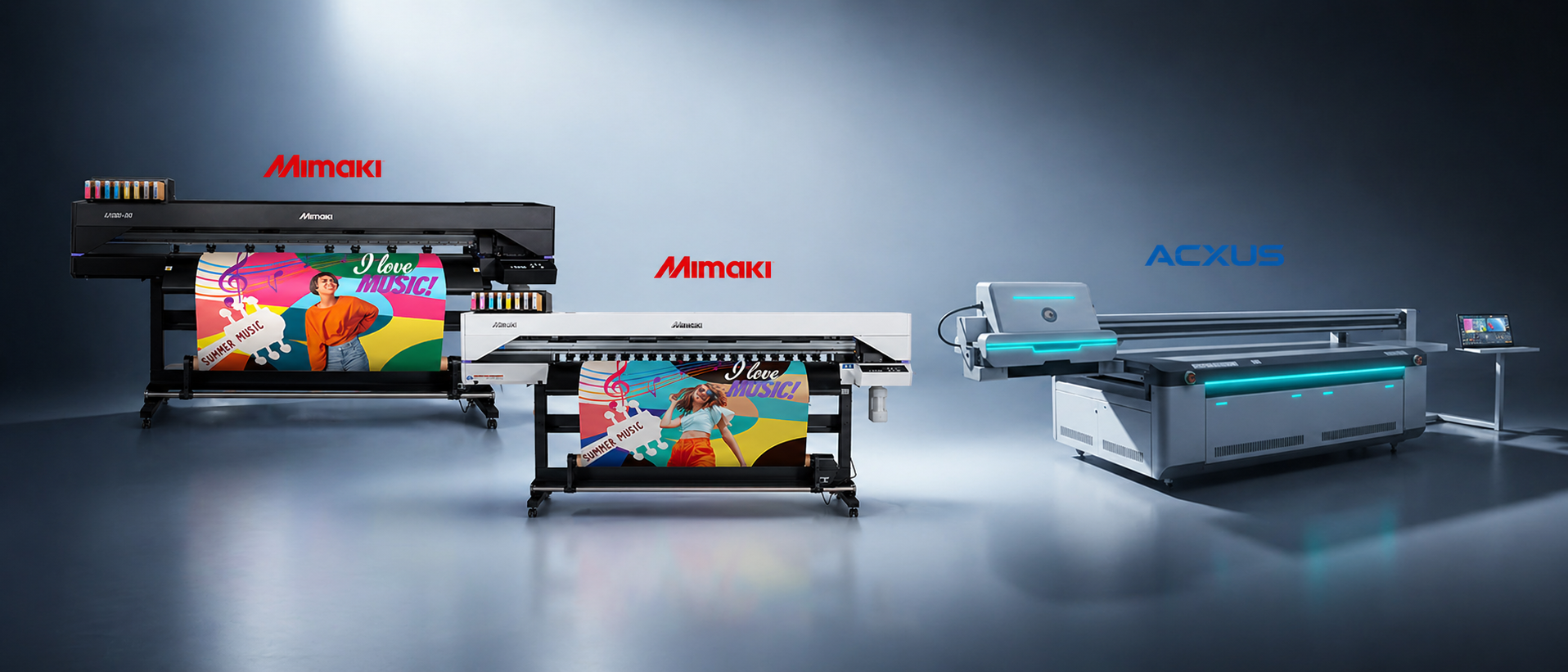
- ACXUS offers practical UV printing solutions for startups and SMEs; Mimaki covers premium industrial production
- ROI for active sellers and print shops is typically 3–6 months when replacing outsourced printing
In This Article
1. What Is a UV Printer?
A UV printer is a digital printing machine that uses ultraviolet (UV) light to instantly cure — or harden — ink as it is deposited onto a surface. Unlike conventional inkjet machines that rely on heat or air drying, UV printing cures ink in real time, producing prints that are immediately dry, waterproof, and scratch-resistant.
The key advantage of this technology is its ability to print directly on almost any rigid or flexible material — without the need for transfer paper, heat presses, or pre-treatment in most cases. This makes UV printing exceptionally versatile for Malaysian businesses in signage, manufacturing, gifts, and e-commerce.
How UV Printing Works
The printhead deposits UV-curable ink onto the surface. As the ink lands, UV LED lamps mounted on the carriage instantly cure and bond the ink to the substrate. The result: a durable, vibrant print with no smearing, no waiting, and no lamination required.
2. What Can a UV Printer Print On?
One of the biggest advantages of UV printing technology is material versatility. A single UV flatbed machine can handle an enormous range of substrates:
- Acrylic — signage, awards, plaques, display stands, retail displays
- PVC foam board — signage panels, exhibition boards, point-of-sale displays
- KT board — lightweight signage, indoor displays, event boards
- Wood — keychains, souvenirs, home décor panels, furniture branding
- Glass — photo prints, decorative panels, perfume bottle branding
- Metal — nameplates, industrial tags, aluminium panels, awards
- Ceramic tile — custom home décor, café branding, architectural tiles
- Leather — wallets, notebook covers, luggage tags, branded goods
- Phone cases — plastic, TPU, silicone, and hard case personalisation
- Packaging samples — rigid box printing, premium product packaging
- Promotional products — USB drives, power banks, pen holders, coasters
For flexible materials such as stickers, vinyl, and banner film, a UV roll-to-roll or hybrid machine is more appropriate.
3. Common UV Printer Applications in Malaysia
UV printing equipment is used across a wide range of industries in Malaysia. Here are the most common commercial applications:
- Signage and advertising boards — printing on acrylic, aluminium composite, and PVC panels for indoor and outdoor signage
- Acrylic signage — backlit acrylic letters, frosted panels, retail display signage with white ink underlay
- Corporate gifts — branded plaques, awards, desk accessories, and promotional merchandise for B2B gifting
- Phone case printing — custom name/photo cases for iPhone and Samsung; high-margin e-commerce product
- Product packaging — rigid box samples, luxury packaging prototypes, short-run custom boxes
- Custom labels — product labels on bottles, tins, and containers without adhesive paper
- Interior decoration panels — printed acrylic wall art, restaurant menu boards, hotel lobby panels
- Industrial marking — serial numbers, barcodes, and product identification on metal and plastic components
4. Main Types of UV Printers
Not all UV printing machines are the same. The right type depends on your materials, production volume, and business model. Here is a comparison of the four main categories:
| Type | Best For | Materials | Suitable Business |
|---|---|---|---|
| UV Flatbed Printer | Rigid materials up to a fixed thickness | Acrylic, wood, glass, PVC board, metal, ceramic | Signage shops, gift suppliers, packaging companies |
| UV Roll-to-Roll Printer | Flexible media in roll format | Sticker, vinyl film, banner, flexible packaging | Sticker printers, banner producers, label makers |
| UV Hybrid Printer | Both rigid boards and roll media | PVC board + roll film, acrylic + sticker | Growing print shops wanting one machine for all jobs |
| Small UV Printer | Personalised items and custom gifts | Phone cases, keychains, small plaques, coasters | Startup entrepreneurs, Shopee/Lazada sellers, kiosks |
Which Type Should You Choose?
If your business focuses on acrylic signage, PVC boards, and corporate gifts — a UV flatbed printer is the right choice. If you produce stickers, vehicle wraps, or banner graphics — go with a UV roll-to-roll or hybrid. For personalised product startups, a compact UV flatbed like the AC-FB6090 is the most practical entry point.
5. How to Choose the Right UV Printer
Choosing a UV printing machine in Malaysia involves more than just comparing price tags. Here are the key factors to evaluate before you buy:
Print Size
Match the print area to your largest typical job. A 600×900mm flatbed covers most gift and signage work. For full-size boards (1220×2440mm), you need a large-format machine like the AC-FB2513.
Material Type and Thickness
Confirm the equipment supports the substrate thickness you need. Some UV flatbeds handle materials up to 200mm thick; others are limited to thin phone cases and cards.
Production Volume
A compact UV flatbed is ideal for 50–500 items per month. High-volume signage and packaging production requires an industrial-grade system with faster print speeds.
White Ink Support
White ink is essential for printing on transparent acrylic, dark substrates, and coloured materials. Without white ink, colours appear washed out on non-white surfaces. Always verify this capability.
Varnish Effect
Varnish adds a raised texture or gloss finish to specific areas of the print. This is used for premium gift items, braille-effect signage, and high-end packaging. Not all machines include this.
Printhead Quality and Lifespan
The printhead is the most critical — and expensive — component of any UV printing system. Epson, Ricoh, and Konica Minolta printheads are industry benchmarks. Ask about replacement cost and lifespan before buying.
RIP Software Compatibility
RIP (Raster Image Processor) software controls colour output, white ink layering, and varnish channels. Ensure the machine comes with professional RIP software or supports popular options like Wasatch or AccuRIP.
Spare Parts and Ink Supply
Downtime costs money. Confirm that spare parts and UV inks are available locally in Malaysia — not on a 4–6 week overseas order cycle.
Local Technical Support
Installation, calibration, operator training, and on-site troubleshooting should all be available locally. A machine purchased from an overseas-only supplier creates long-term operational risk.
Demo Before Purchase
Always request a live print demo on your actual materials before committing. Print quality can vary significantly between brands and models — seeing is believing.
6. ACXUS UV Printer and Mimaki UV Printer Options
ACXUS distributes both its own practical UV printing range and Mimaki's premium Japanese systems in Malaysia. Here is how they compare:
ACXUS UV Printers — Practical Value with Full Local Support
ACXUS machines are designed for Malaysian SMEs, startups, and signage workshops that need reliable UV printing performance at accessible pricing. All equipment is stocked locally in Semenyih, Selangor with in-house installation, training, and ongoing technical support.
- AC-FB6090 — compact 900×600mm UV flatbed for personalised products, gifts, and small-batch signage. Ideal for Shopee/Lazada sellers and startup entrepreneurs.
- AC-FB2513 — large-format UV flatbed for full-size board printing (1220×2440mm and above), suited for signage shops and acrylic fabricators handling high-volume production.
Mimaki UV Printers — Premium Japanese Technology for Industrial Production
Mimaki UV printers represent the gold standard for high-volume, precision UV printing in Malaysia. With advanced printhead technology, superior colour management, and robust build quality, Mimaki systems are the choice for professional print shops, packaging companies, and industrial applications that demand the highest output quality and uptime reliability.
Mimaki UV options available through ACXUS include UV flatbed, UV roll-to-roll, and print-and-cut configurations depending on your production requirements.
| Factor | ACXUS UV Printers | Mimaki UV Printers |
|---|---|---|
| Price range | More accessible — suitable for SMEs | Premium — industrial investment |
| Target user | Startups, gift shops, signage SMEs | High-volume print shops, packaging companies |
| Print quality | Professional quality for most applications | Industry-leading precision and colour fidelity |
| Local support | Full local team in Semenyih, Selangor | Supported by ACXUS Malaysia team |
| Best for | Gifts, signage, personalised products | High-volume signage, packaging, industrial |
7. Why Local Support Matters When Buying a UV Printer
Many Malaysian businesses make the mistake of prioritising machine price over after-sales support. With UV printing equipment, this decision can be costly. Here is why local support is non-negotiable:
- Installation: UV printing systems require professional installation and calibration. A misaligned printhead or improperly configured ink channel affects every print job from day one.
- Operator training: RIP software, white ink management, material height adjustment, and print profiling all require hands-on training for consistent output quality.
- Maintenance schedules: Printhead cleaning, ink system flushing, and UV lamp checks are routine but critical. Local support ensures these are done correctly.
- Ink supply: Running out of UV ink or white ink can halt production. Local stock means next-day replenishment, not a 2–4 week overseas order.
- Spare parts: Printhead replacements, UV lamps, and carriage components must be available locally to minimise costly downtime.
- Troubleshooting: When something goes wrong, having a local technical team that can visit your site is worth more than any price saving on the equipment itself.
- Demo before purchase: A local supplier can demonstrate the machine on your actual materials at their showroom — so you know exactly what you are buying.
ACXUS operates from its headquarters and showroom in Semenyih, Selangor, with a dedicated technical team handling all installation, training, support, and parts supply for customers across Malaysia.
8. Who Should Buy a UV Printer in Malaysia?
UV printing equipment delivers the strongest return on investment for businesses that currently outsource printing, have growing demand for customised products, or want to add new revenue streams. The best candidates include:
- Signage shops — replace outsourced acrylic and PVC board printing with in-house UV flatbed production
- Print shops — expand beyond paper printing into rigid materials, gifts, and promotional merchandise
- Acrylic fabricators — add direct UV printing to acrylic cut pieces without outsourcing to a separate vendor
- Packaging companies — produce rigid box samples, short-run custom packaging, and premium product prototypes
- Corporate gift suppliers — produce branded plaques, awards, and desk accessories on demand for B2B clients
- Interior decoration companies — create printed wall panels, architectural tiles, and custom décor elements
- E-commerce customisation sellers — Shopee and Lazada entrepreneurs selling personalised phone cases, keychains, and gifts
Not Sure Which Machine Fits Your Business?
ACXUS offers free consultations and live demos at its Semenyih showroom. Bring your materials, describe your production volumes, and the team will recommend the right UV printing solution for your specific needs and budget.
Looking for a UV Printer in Malaysia?
Contact ACXUS to compare UV flatbed, roll-to-roll, and hybrid printer options, arrange a demo at our Semenyih showroom, or request a quotation tailored to your production needs.
WhatsApp ACXUS Now →9. Frequently Asked Questions
What is a UV printer used for?
UV printing equipment is used to print directly on rigid and flexible materials — including acrylic, wood, glass, metal, ceramic, leather, phone cases, and promotional products. It is widely used in Malaysia for signage, corporate gifts, personalised products, and industrial marking.
Can a UV printer print on acrylic?
Yes. UV printing on acrylic is one of the most common applications in Malaysia. The UV ink bonds directly to the acrylic surface and cures instantly for a durable, scratch-resistant finish. For transparent acrylic, white ink is applied as a base layer to make colours vivid and opaque.
Can a UV printer print on glass and metal?
Yes. These machines can print on flat glass panels, metal plates, and aluminium sheets. The UV ink adheres directly to the surface without primers in most cases. This makes the technology ideal for decorative glass, metal nameplates, industrial tags, and trophy plates.
Is a UV printer suitable for a signage business?
Absolutely. UV flatbed machines are the industry standard for signage production in Malaysia. They print directly on acrylic, PVC foam board, aluminium composite panel, and KT board at high resolution — eliminating the need for vinyl application on many jobs.
What is the difference between a UV flatbed printer and a UV roll-to-roll printer?
A UV flatbed machine prints on rigid materials laid flat on a stationary bed — acrylic, wood, glass, PVC boards, phone cases, and similar items. A UV roll-to-roll machine feeds flexible media from a roll and prints on stickers, vinyl film, canvas, and banner material. A UV hybrid system combines both capabilities in one unit.
Does a UV printer need regular maintenance?
Yes. UV printing systems require regular printhead cleaning, ink system flushing, UV lamp checks, and carriage rail lubrication. Most tasks are routine and can be done by the operator after training. ACXUS provides hands-on maintenance training during installation for all machines sold in Malaysia.
Where can I buy a UV printer in Malaysia?
ACXUS is a UV printer supplier based in Semenyih, Selangor, offering both its own ACXUS range and Mimaki UV printing systems. All purchases include local installation, operator training, and ongoing technical support. Visit the ACXUS showroom or contact the team via WhatsApp to arrange a demo and quotation.