
How a Flatbed Cutting Machine Can Save Time and Reduce Costs for Malaysian Sign Makers
Discover how automated cutting can improve production efficiency, reduce material waste and help your printing business handle more orders.
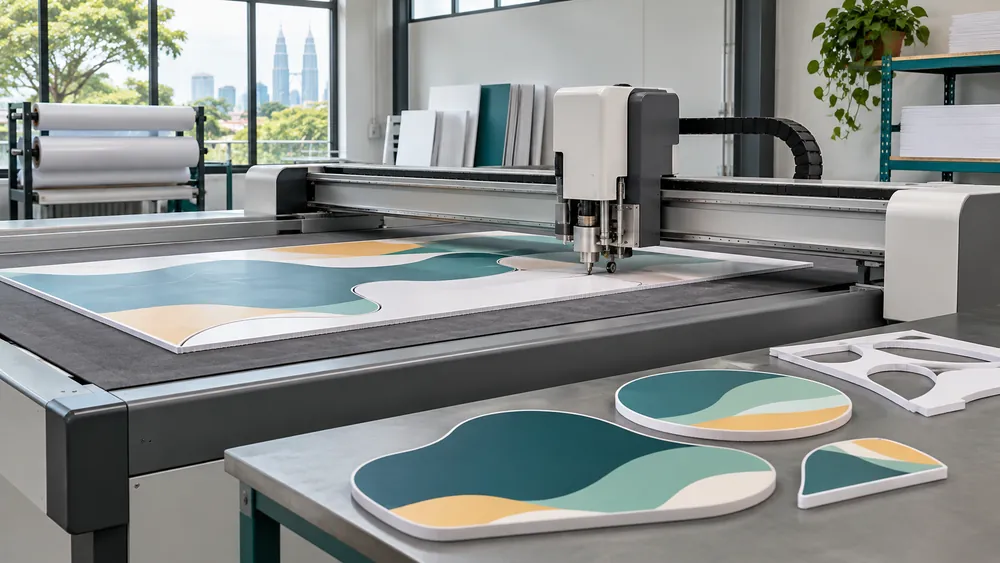
Illustration of a generic cutting workshop.
Your printing machine finishes a job in minutes, but your production team spends hours cutting, trimming and correcting the finished boards.
For many Malaysian signage and large-format printing businesses, cutting is one of the hidden bottlenecks in the production process.
As orders increase, business owners often face the same challenges: longer working hours, inconsistent cutting quality, material wastage and increasing labour requirements.
Hiring more workers may seem like the obvious solution. But what if your existing team could complete more orders without increasing your workforce?
A digital flatbed cutting machine could help transform your production workflow by automating repetitive cutting tasks, improving consistency and freeing up valuable production time.
At a Glance
- Reduce repetitive manual cutting work.
- Improve cutting consistency and material utilisation.
- Increase production capacity without immediately expanding your workforce.
- Reduce reliance on outsourced cutting services.
- Explore new signage, packaging and customised finishing applications.
Actual savings depend on production volume, material types, machine configuration and operating costs.
How a Japanese Sign Shop Halved Its Cutting Time
For Japanese signage company TWOPIECE, manual cutting had become a production challenge.
The company regularly worked with styrene boards and aluminium composite panels. Cutting these materials by hand required considerable time, while imperfect cuts sometimes created additional finishing work.
When urgent orders arrived, the pressure increased. Panel-cutting work could involve the entire team, taking employees away from other production activities.
The company subsequently introduced a Mimaki CFX flatbed cutting machine into its workflow.
According to Mimaki’s published customer case study, panel-cutting work that previously involved multiple team members could be handled by one person in approximately half the time.
TWOPIECE also reported being able to complete more work internally and reduce its reliance on outsourced cutting.
For Malaysian sign makers facing similar production challenges, this case highlights an important opportunity: improving cutting and finishing efficiency can be just as valuable as investing in faster printing equipment.
Source: Mimaki’s TWOPIECE customer case study. The reported results relate to the Mimaki CFX and are not performance claims for the RUK ACM-1625 or an ACXUS customer.
5 Ways a Flatbed Cutting Machine Can Reduce Production Costs
1. Reduce Manual Cutting Time
Manual cutting requires employees to measure, trim and finish materials individually. Digital cutting can automate many repetitive tasks, allowing operators to focus on printing, assembly and other production activities.
2. Reduce Material Waste
With suitable cutting software, layout planning and tooling, businesses may improve material utilisation and reduce rejected pieces caused by inconsistent manual cutting.
Even small savings per sheet can become significant when repeated across hundreds of production jobs.
3. Increase Production Capacity
When less time is spent on manual finishing, your existing production team can potentially handle more orders, improve turnaround times and reduce overtime requirements.
4. Reduce Outsourcing Costs
Businesses that outsource selected cutting jobs may be able to bring suitable applications in-house, reducing external processing fees, transportation requirements and waiting times.
5. Improve Cutting Consistency
Digital cutting can deliver more repeatable results when correctly configured, particularly for jobs involving repeated shapes, customised contours and complex designs.
Improved consistency can reduce rework and help maintain the quality of finished products.
How Much Could a Flatbed Cutting Machine Save Your Business?
Consider a Malaysian signage business handling approximately 40 board-cutting jobs every month.
Assume that automated cutting reduces finishing time from two hours to one hour per job. The business could free up 40 production hours every month.
Using an illustrative labour cost of RM25 per hour and material savings of RM5 per job, the potential value is calculated below.
| Monthly Production Calculation | Potential Value |
|---|---|
| Number of cutting jobs | 40 jobs |
| Time saved per job | 1 hour |
| Monthly production hours freed | 40 hours |
| Labour capacity value | RM1,000 |
| Potential material savings | RM200 |
| Monthly gross potential value | RM1,200 |
| Annual gross potential value | RM14,400 |
480 Hours of Additional Production Capacity Per Year
In this example, the business gains approximately 480 hours of production capacity annually.
These hours could be used to handle additional orders, reduce overtime or improve delivery schedules.
The figures are illustrative, not actual customer savings. Freed labour hours only become direct cash savings if paid working hours or overtime decrease. Equipment, maintenance, tooling and operating costs must also be considered.
Flatbed Cutting Machine Savings Calculator
Every printing business operates differently. Use our calculator to estimate the potential operational value of automating your cutting process based on your own production volume.
Calculate Your Potential Savings
Enter your monthly production figures below.
These estimates include the value of freed labour capacity and deduct entered running costs. Machine purchase and financing costs are excluded. Avoid double-counting benefits, and verify all assumptions using your actual production data.
Beyond Signboards: What Can a Flatbed Cutting Machine Be Used For?
A digital flatbed cutting machine is not limited to traditional signboard production. Depending on the machine configuration, cutting tools and material compatibility, it can support a wide range of commercial applications.
| Industry | Potential Applications |
|---|---|
| Signage and Advertising | Custom signage, foam boards, display panels and contour cutting. |
| Retail and POS Displays | Promotional stands, customised displays and retail graphics. |
| Packaging | Carton prototypes, customised boxes and packaging samples. |
| Exhibitions and Events | Decorative shapes, exhibition graphics and display components. |
| Industrial Applications | Selected foam, rubber and specialty sheet materials. |
For printing businesses looking to expand beyond conventional signage, digital cutting may create opportunities to introduce new products, attract different customer segments and generate additional revenue.
Supported materials, thicknesses and applications vary according to machine configuration and installed tooling. Always confirm compatibility before purchasing.
Introducing the RUK ACM-1625 Flatbed Cutting Machine
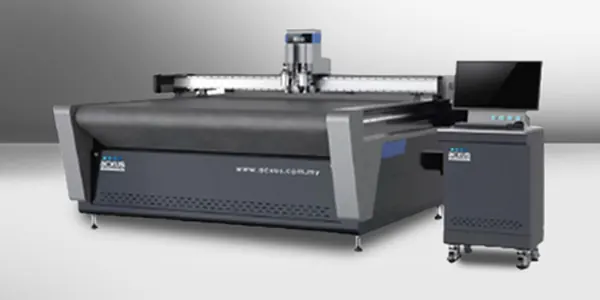
For Malaysian printing businesses looking to transition from manual cutting to automated production, ACXUS offers digital cutting solutions, including the RUK ACM-1625 platform cutting machine.
The ACM-1625 is an option for businesses evaluating automated cutting for signage, advertising, packaging and customised finishing applications, subject to the appropriate tooling and machine configuration.
By integrating digital cutting into your production workflow, your business may be able to reduce repetitive manual work, improve production consistency and handle increasing order volumes more efficiently.
ACXUS has also documented the delivery and installation of an ACM-1625 in Malaysia, demonstrating its local installation capabilities.
Read more: RUK ACM-1625 Platform Cutting Machine Delivered and Installed in Malaysia.
Explore the RUK ACM-1625 Cutting Machine
Looking for a more efficient way to handle your cutting and finishing requirements? Speak to ACXUS about suitable machine configurations, pricing and applications.
Why Choose ACXUS for Flatbed Cutting Machines in Malaysia?
Purchasing a flatbed cutting machine is not simply about comparing machine prices. Installation, operator training, tooling, technical support and long-term service are equally important considerations.
As a Malaysian supplier of large-format printing and cutting equipment, ACXUS helps businesses evaluate solutions based on their production requirements.
-
Competitive Pricing
Explore equipment options according to your production needs and investment budget. -
Machine Selection Assistance
Discuss suitable machine configurations, cutting tools, materials and applications. -
Local Installation Support
Discuss installation requirements for your production facility and selected equipment package. -
Operator Training
Explore available training to help your team transition to digital cutting. -
Local Technical Support
Access local assistance for equipment-related enquiries and technical requirements. -
Spare-Parts Availability
Discuss replacement parts, consumables and long-term maintenance requirements.
Confirm the installation, training, tooling, warranty and support coverage included in your selected equipment quotation.
How to Calculate the Return on Investment of a Flatbed Cutting Machine
Before purchasing a cutting machine, evaluate its potential financial benefits based on your actual production workflow rather than cutting speed alone.
Start by selecting a repeat order that represents the type of work your business regularly handles.
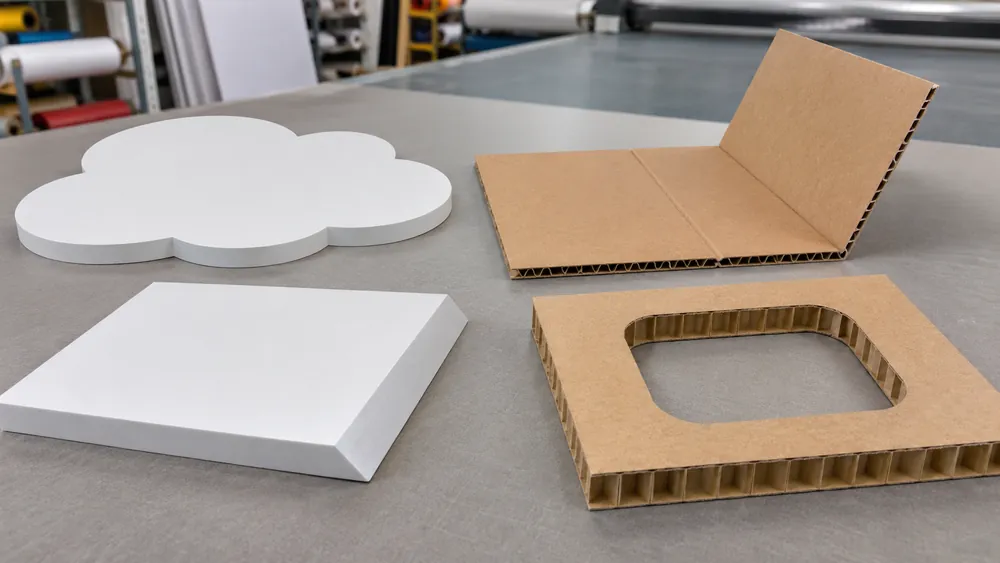
Compare your current manual cutting process with an automated cutting workflow using the following measurements:
- File preparation and machine setup time.
- Material loading and cutting time.
- Number of employees and labour hours required.
- Material usage and rejected pieces.
- Additional manual finishing requirements.
- Outsourced cutting expenses.
- Number of acceptable finished products.
- Maintenance, tooling and operating costs.
The most important measurement is not simply how quickly a machine completes a cut, but how much it costs your business to produce an acceptable finished product.
Simple Machine Payback Formula
Payback Period (Months) = Total Initial Investment ÷ Monthly Net Financial Benefit
For example, if a business invests RM60,000 and achieves a genuine net financial benefit of RM2,500 per month, its estimated simple payback period would be 24 months.
| Illustrative initial investment | RM60,000 |
| Monthly net financial benefit | RM2,500 |
| Annual net financial benefit | RM30,000 |
| Estimated payback period | 24 months |
This is a hypothetical investment example, not an ACXUS machine quotation or guaranteed financial return. Net financial benefit should reflect actual cash savings and additional contribution profit after recurring expenses, without double-counting freed labour capacity.
Is a Flatbed Cutting Machine Worth the Investment?
A flatbed cutting machine may be a worthwhile investment for printing businesses experiencing recurring manual cutting bottlenecks, rising overtime requirements, inconsistent finishing quality or substantial outsourcing costs.
Your business may benefit from automated cutting if:
- Your team spends several hours each week cutting materials manually.
- Cutting and finishing regularly delay customer deliveries.
- You frequently outsource customised cutting jobs.
- Material waste and rejected pieces affect your profit margins.
- You want to increase production without significantly increasing headcount.
- You are exploring new packaging, display or customised product opportunities.
Businesses with limited cutting requirements may find outsourcing more economical until production volumes increase.
The best approach is to evaluate your actual production requirements, test representative materials and calculate the potential financial benefits before making an investment decision.
Still Spending Too Much Time Cutting by Hand?
Your next production upgrade may not be another printing machine. It could be a more efficient cutting and finishing workflow.
Discover how the RUK ACM-1625 and other ACXUS cutting solutions could help your business reduce manual work, improve productivity and handle more orders.
Share your artwork, materials, board sizes and monthly production volume with our team. Let us help you evaluate suitable cutting solutions for your business.
Frequently Asked Questions About Flatbed Cutting Machines
What is a flatbed cutting machine?
A flatbed cutting machine is a computer-controlled cutting system that processes sheet materials on a flat working surface. It is commonly used for signage, advertising displays, packaging and customised finishing applications. Supported materials depend on the machine and installed tooling.
How much does a flatbed cutting machine cost in Malaysia?
The price of a flatbed cutting machine in Malaysia depends on the working area, cutting tools, software, automation features and installation package. Contact ACXUS for a quotation based on your materials and production requirements.
Can a flatbed cutting machine reduce labour costs?
A flatbed cutting machine can reduce repetitive manual cutting work and potentially reduce overtime or additional labour requirements. Actual financial savings depend on production volume, operating costs and how the business uses its additional production capacity.
What materials can a digital flatbed cutter cut?
Depending on the machine configuration and cutting tools, digital flatbed cutters can process materials such as foam boards, cardboard, corrugated sheets and selected specialty materials. Confirm material compatibility and maximum supported thickness with the supplier.
Can the RUK ACM-1625 reduce cutting time by 50%?
The 50% reduction discussed in this article was reported by TWOPIECE using a Mimaki CFX, not the RUK ACM-1625. Actual ACM-1625 performance should be evaluated using your own artwork, materials, job quantities and selected machine configuration.
How do I calculate the payback period of a flatbed cutting machine?
Calculate potential cash savings and additional contribution profit, then deduct recurring operating expenses. Divide the total initial investment by the positive monthly net financial benefit to estimate the simple payback period.
Is a flatbed cutting machine suitable for small printing businesses?
A flatbed cutting machine may be suitable for small printing businesses with frequent cutting jobs, substantial outsourcing costs or production bottlenecks. Businesses with low cutting volumes should compare equipment ownership costs with outsourcing before investing.
What should I prepare for a cutting machine demonstration?
Prepare artwork from a representative production order, actual materials, required quantities and an acceptable finished sample. Ask the supplier whether a sample-cutting demonstration can be arranged and confirm the tools and software required.
Where can I buy a flatbed cutting machine in Malaysia?
ACXUS supplies large-format cutting equipment in Malaysia, including the RUK ACM-1625. Businesses can contact ACXUS to discuss machine selection, pricing, material compatibility, installation, training and local technical support.
Explore More Cutting Solutions from ACXUS
Flatbed Cutting Machine Digital Cutting Machine Malaysia RUK ACM-1625 Signage Production Cutting Automation Production Cost Savings