
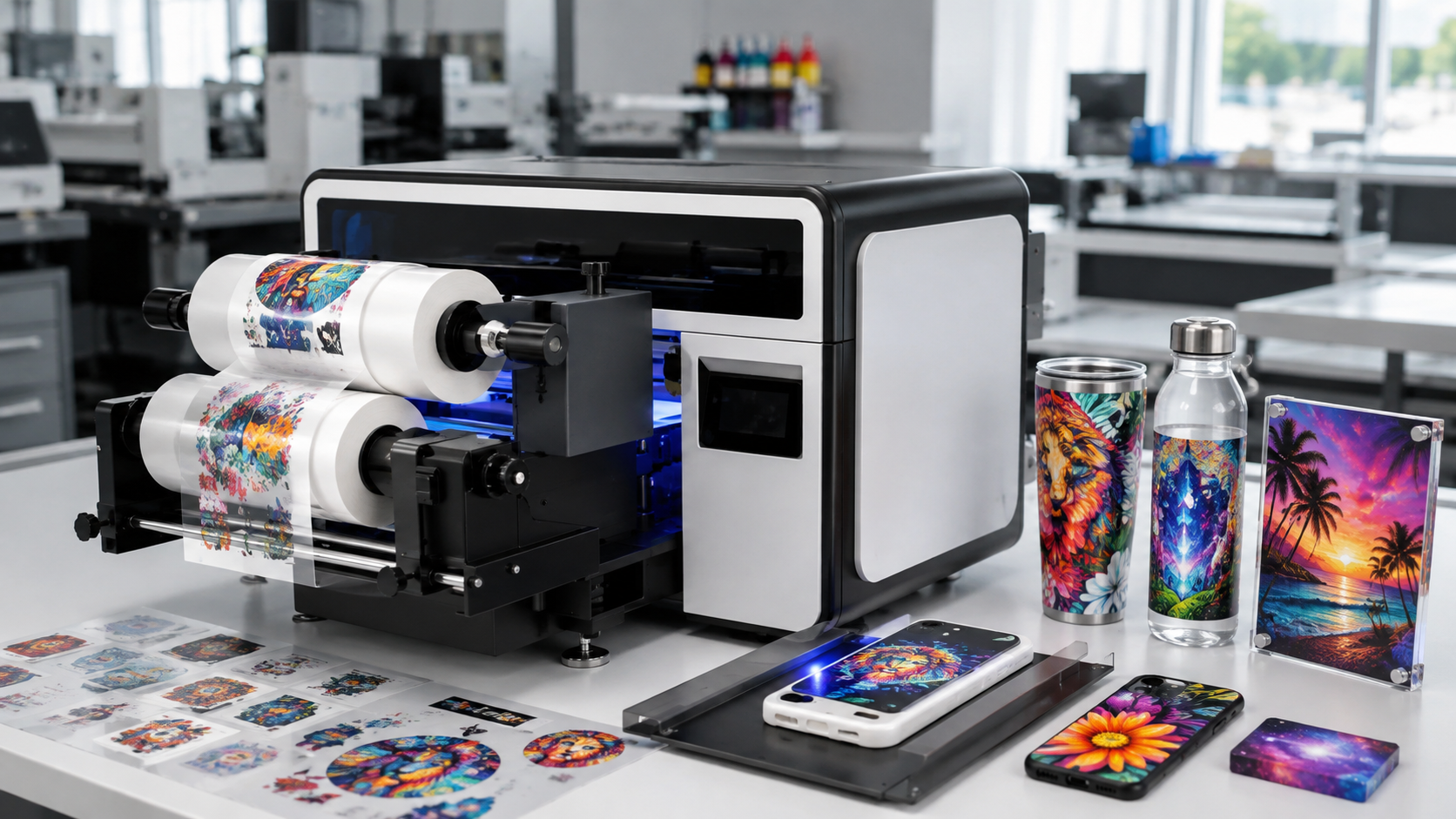
Looking for a DTF printer for bottles but not sure which type of printing machine you actually need? Choosing the right printing technology can make a major difference to your production workflow, product range and business opportunities. When searching for a DTF printer for bottles, Malaysian print shops, gift businesses and promotional-product suppliers may come across textile DTF, UV DTF transfer printing and direct UV printing. The best option depends on the products you customise, the materials you handle and whether you need flatbed, cylindrical or transfer printing applications.
Quick Summary: A conventional textile DTF printer is designed mainly for transferring printed designs onto garments and fabric. For bottles, tumblers, acrylic gifts and other hard products, businesses typically consider a UV DTF printer for bottles, UV DTF transfer printing or direct UV printing solutions. The ACXUS UV-A3 is a multifunction A3 UV printing machine designed for flatbed and cylindrical printing applications, using CMYK, white and varnish UV-curable ink. It is worth considering for businesses looking for a versatile bottle printing machine and product customisation solution rather than a machine focused only on textile printing.
Key Takeaways
- A textile DTF printer and a UV printing machine are designed for different production needs and product applications.
- Businesses searching for a DTF printer for bottles should first determine whether they need UV DTF transfer printing or direct UV printing.
- A UV DTF printer for bottles and a direct UV printer can provide different workflows, so businesses should compare their actual production requirements before investing.
- The ACXUS UV-A3 combines A3 flatbed printing with cylindrical printing capabilities for selected product customisation applications.
- CMYK, white and varnish UV-curable ink can help businesses produce detailed customised graphics on suitable hard-surface products.
- The UV-A3 is worth considering for gift, promotional-product, signage and custom-printing businesses that need more application flexibility.
Table of Contents
- What Is a DTF Printer for Bottles?
- DTF Printer vs UV DTF Printer for Bottles
- Why This Matters for Malaysian Buyers
- What Can You Print or Customise?
- Introducing the ACXUS UV-A3
- DTF and UV Printing Options Compared
- How to Choose the Right Printing Solution
- Why Consider the ACXUS UV-A3?
- Why Buy from a Local Supplier in Malaysia?
- FAQ: DTF Printer for Bottles
What Is a DTF Printer for Bottles?
When buyers search for a DTF printer for bottles, they may actually be looking for one of two different printing approaches. The first is UV DTF transfer printing, where a design is printed onto specialised transfer film before being applied to a suitable hard surface. The second is direct UV printing, where UV-curable ink is printed directly onto a compatible product or material.
This distinction is important because a conventional textile DTF printer is primarily designed for garment and fabric applications. It is not automatically the right machine for printing bottles, tumblers, acrylic products or other rigid items. If you are looking for a DTF printer for bottles, it is therefore important to understand what type of DTF or UV printing workflow your business actually requires.
If your business sells personalised gifts or promotional products, your machine selection should start with the product you want to customise. A T-shirt printing business may prioritise a textile DTF workflow, while a gift shop or promotional-product supplier may need a bottle printing machine, UV DTF printer for bottles or direct UV printing solution for hard surfaces and cylindrical products.
Direct Answer for Buyers
If your main products are bottles, tumblers, acrylic gifts and other hard-surface items, do not choose a machine simply because it is marketed as a "DTF printer." First confirm whether you need textile DTF, UV DTF transfer printing or direct UV printing. If you are looking for a DTF printer for bottles that can also support other product customisation applications, a multifunction UV printer such as the ACXUS UV-A3 is worth evaluating based on your actual products and materials.
DTF Printer vs UV DTF Printer for Bottles: What Is the Difference?
The term DTF stands for Direct to Film, but the printing workflow changes depending on the type of DTF technology being used. This is why buyers comparing a DTF printer for bottles with a UV DTF printer for bottles should carefully understand the difference between textile DTF and UV printing technologies.
Textile DTF Printing
Traditional textile DTF printing is commonly used to produce transfers for garments and fabric. The design is printed onto film and prepared for transfer onto textiles, typically as part of a workflow involving adhesive powder and heat application.
This type of DTF printer is generally a better fit for businesses focused on T-shirts, apparel, uniforms, tote bags and other fabric products. If your main business is garment printing, a textile DTF machine may be more appropriate than a bottle printing machine.
UV DTF Transfer Printing
UV DTF is designed for applications involving hard surfaces. A UV-curable design is prepared on specialised transfer media and then applied to suitable products such as bottles, cups, packaging and promotional items.
A UV DTF printer for bottles can be relevant for businesses that want to customise hard-surface products without relying on a conventional textile DTF workflow. UV DTF can be useful when the product shape or surface makes direct printing difficult. However, businesses should confirm the exact printer configuration, film compatibility and transfer workflow before purchasing a machine.
Direct UV Printing
Direct UV printing uses UV-curable ink that is cured during the printing process. Depending on the machine configuration, UV printers can print directly onto compatible rigid materials and products.
This approach can be attractive for businesses that want to print directly onto materials such as acrylic, glass, wood, leather, ceramic and selected metal surfaces. An A3 UV printer with cylindrical printing capability can also open up opportunities for bottles, tumblers and similar products.
For businesses comparing a DTF printer for bottles with a direct UV printing solution, the key question is how the printing process fits into your existing production workflow. UV DTF transfers and direct UV printing can both serve hard-surface applications, but they involve different production methods and equipment requirements.
Why This Matters for Malaysian Buyers
Malaysian businesses involved in personalised products are often handling a wide variety of short-run jobs. One customer may request a customised bottle, another may need an acrylic display, while another may want a personalised phone case or promotional item.
If your business only handles one product type, a specialised machine may be sufficient. However, if you want to expand your product range, a multifunction UV printing solution can provide more flexibility. This is one reason businesses may compare an A3 UV printer, UV flatbed printer Malaysia options and dedicated bottle printing machines before making an investment.
This is particularly relevant for print shops, gift businesses, advertising suppliers and promotional-product companies that want to reduce outsourcing for selected jobs. Bringing suitable printing work in-house can give businesses greater control over production scheduling, customisation and order turnaround.
The key is to match the machine to your actual production needs. Before investing in a DTF printer for bottles or another type of printing machine, consider the products you sell today, the products you plan to introduce and the materials your customers commonly request.
What Can You Print or Customise?
The ACXUS UV-A3 is designed for a range of UV printing applications. Its A3 flatbed format and cylindrical printing capability make it relevant to businesses working with both flat materials and selected round products.
Depending on material compatibility and the specific application, potential jobs include:
- Bottles and cylindrical promotional products
- Tumblers and similar cylindrical items
- Phone cases
- Power banks
- Acrylic gifts and displays
- Metal nameplates and selected metal products
- Leather products
- Wood products
- Glass products
- Ceramic tiles and selected ceramic items
The machine supports CMYK, white and varnish UV-curable ink. The addition of white and varnish can be useful for applications where businesses need additional visual effects or want to print on selected coloured or transparent materials.
For businesses comparing a DTF printer for bottles with an A3 UV printer, product compatibility should always be considered before purchase. Surface coating, shape, texture and ink adhesion can affect the final result.
Before production, businesses should always test their actual material or product. This is especially important when evaluating a bottle printing machine or tumbler printing machine because different product coatings and surface finishes can affect print performance.
Introducing the ACXUS UV-A3 Series Inkjet Printer
For businesses that want to move beyond a single application, the ACXUS UV-A3 Series Inkjet Printer is positioned as a compact multifunction UV printing solution.
The machine is designed around an A3 print format, with a printable area of up to approximately 420 × 297 mm. This makes it suitable for small-format product customisation and printing applications where a large industrial flatbed is unnecessary.
One of the key advantages is its ability to support different printing applications. In addition to A3 flatbed printing, the machine can be configured for cylindrical printing applications and narrow roll-media printing.
For businesses considering a DTF printer for bottles, this multifunction approach is worth examining because it provides an alternative route to product customisation. Instead of limiting the business to textile transfer work, the machine can be used for a broader range of UV printing jobs, subject to the compatibility of the product and material.
ACXUS UV-A3 Series Inkjet Printer
The ACXUS UV-A3 is an A3 multifunction UV printer designed for businesses that need flexibility across flatbed, cylindrical and selected roll-media applications. It uses CMYK, white and varnish UV-curable ink and is suitable for a variety of hard-surface printing applications. If you are searching for a DTF printer for bottles but also need flexibility for other customised products, the UV-A3 is worth evaluating. View the ACXUS UV-A3 Series Inkjet Printer to explore the machine specifications and application possibilities.
DTF and UV Printing Options Compared
The right machine depends on what you intend to produce. Use the comparison below as a starting point before discussing your specific application with a machine supplier.
| Printing Option | Best For | Common Use | Suitable Buyer |
|---|---|---|---|
| Textile DTF Printer | Garments and fabric | T-shirts, apparel, uniforms and tote bags | Textile printing businesses |
| UV DTF Transfer Printing | Hard-surface product transfers | Bottles, cups, gifts and selected promotional products | Custom gift and promotional-product businesses |
| UV Flatbed Printing | Flat rigid or compatible materials | Acrylic, wood, glass, leather and selected boards | Print shops, signage businesses and product customisers |
| UV Printing with Cylindrical Capability | Selected round products | Bottles, tumblers and cylindrical promotional items | Businesses offering personalised products |
The comparison shows why the term "DTF printer" alone may not be enough when you are choosing a machine. If your business handles both flat products and cylindrical items, a multifunction UV printer may be more relevant than a dedicated textile DTF system.
If you are specifically searching for a DTF printer for bottles, compare the complete workflow rather than focusing only on the machine name. Consider whether you need a UV DTF transfer workflow, a direct-printing solution or a combination of flatbed and cylindrical printing capabilities.
How to Choose the Right Printing Solution
1. Check Your Main Production Need
Start with the products you expect to print most frequently. If your main business is T-shirt printing, a textile DTF workflow may be the appropriate direction. If you mainly customise bottles, acrylic gifts or other hard products, investigate UV DTF and direct UV printing options instead.
2. Consider Material Size and Product Shape
A UV flatbed printer Malaysia businesses use for flat products can be useful for rigid materials and sheet products, while cylindrical printing capability can help businesses handle selected round products. If you need both, consider a multifunction machine such as the ACXUS UV-A3 and evaluate whether its print area and cylindrical specifications fit your products.
3. Review Ink Configuration
Consider whether you need CMYK only or whether white and varnish are important to your applications. The ACXUS UV-A3 uses CMYK, white and varnish UV-curable ink, giving businesses additional flexibility for suitable applications.
4. Consider Production Volume
An A3 UV printer can be suitable for small-format customisation and short-run production. However, businesses with high-volume continuous production should compare output requirements, workflow and machine configuration carefully.
5. Test Your Own Products Before Buying
This is one of the most important steps when choosing a DTF printer for bottles or any other product printing machine. Bring or send your actual bottles, tumblers, acrylic items, boards or other products for testing where possible. The result can depend on the surface, coating, shape and material composition.
6. Check Supplier Support
A printing machine is only part of the investment. Ask about installation, operator training, maintenance, ink supply, spare parts and after-sales support. These factors can affect the long-term practicality of running a bottle printing machine, tumbler printing machine or A3 UV printer in Malaysia.
Why Consider the ACXUS UV-A3?
The ACXUS UV-A3 is particularly relevant for businesses that want to expand their custom-printing capabilities without immediately moving into a larger industrial UV printer.
Its multifunction format can be useful for businesses handling a mix of applications. The A3 flatbed area provides a platform for small-format direct printing, while the cylindrical printing capability opens opportunities for selected bottle and tumbler applications.
The machine's CMYK, white and varnish UV-curable ink configuration can also support a variety of visual requirements across compatible materials. For businesses selling personalised products, this can help create a broader product offering.
Potential users include:
- Custom gift businesses
- Promotional-product suppliers
- Print shops
- Signage and advertising businesses
- Souvenir and personalised-product sellers
- Small and medium-sized businesses bringing selected printing jobs in-house
If your business is specifically searching for a DTF printer for bottles, the important next step is to determine whether your workflow is better suited to UV DTF transfer printing or direct UV printing. The ACXUS UV-A3 should be evaluated based on the exact products you intend to print and the required production workflow.
For businesses interested in UV DTF film production specifically, confirm the exact A/B film compatibility, transfer workflow and any required laminating equipment with ACXUS before purchase. This ensures the machine configuration matches your intended application.
Why Buy from a Local Supplier in Malaysia?
Choosing a printing machine is not only about comparing specifications online. For Malaysian B2B buyers, local supplier support can be an important part of the purchasing decision.
A local machine supplier can help you evaluate whether a printer is suitable for your materials and production requirements. This is particularly useful when your business handles different products or when the final print quality depends on surface preparation and ink adhesion.
Before purchasing a DTF printer for bottles, bottle printing machine or A3 UV printer, ask about:
- Machine demonstration and sample testing
- Installation and operator training
- Recommended UV inks and consumables
- Spare parts availability
- Routine maintenance requirements
- Technical support and after-sales service
- Compatibility testing for your actual products
For a business investing in new printing equipment, these questions can be just as important as the headline print speed or machine size.
Ready to Find the Right DTF Printer for Bottles?
Tell ACXUS what you want to print, including your bottle or product type, material, size, expected production volume and current printing workflow. If possible, provide a sample or product specification so the team can help you assess whether the ACXUS UV-A3 is suitable for your application.
FAQ: DTF Printer for Bottles
Can a DTF printer print directly on bottles?
A conventional textile DTF printer is not designed for direct bottle printing. Businesses looking to customise bottles should consider UV DTF transfer printing or a UV printer with suitable cylindrical printing capabilities. The correct option depends on the bottle material, shape and required workflow. If you are comparing a DTF printer for bottles with a direct UV printing machine, testing your actual products is recommended.
What is the difference between DTF and UV DTF?
Textile DTF is mainly used to create transfers for garments and fabric. UV DTF is intended for transferring UV-printed graphics onto suitable hard surfaces. They use different inks, workflows and application methods, so buyers should choose based on the products they want to customise.
Is the ACXUS UV-A3 a textile DTF printer?
The ACXUS UV-A3 is a multifunction UV printer rather than a conventional textile DTF printer. It uses UV-curable CMYK, white and varnish ink and is designed for applications including flatbed and cylindrical printing on suitable products and materials.
Can the ACXUS UV-A3 print bottles and tumblers?
The UV-A3 supports cylindrical printing applications using its rotary printing capability. Its listed cylindrical application range is approximately 30–90 mm in diameter. Businesses should test their specific bottles or tumblers before purchase to confirm surface and product compatibility. This is particularly important when comparing a bottle printing machine or tumbler printing machine for commercial production.
What materials can the ACXUS UV-A3 print on?
The machine is designed for suitable materials and products including acrylic, aluminium board, ceramic tiles, glass, wood and leather. It can also be used for selected product-customisation applications such as phone cases, power banks and nameplates. Actual print performance should be confirmed with sample testing.
Does the ACXUS UV-A3 use white and varnish ink?
Yes. The ACXUS UV-A3 uses a CMYK, white and varnish UV-curable ink configuration. This allows businesses to explore a wider range of suitable printing applications and visual effects compared with a CMYK-only configuration.
Who should consider an A3 UV printer?
An A3 UV printer can be suitable for print shops, custom gift businesses, promotional-product suppliers, signage businesses and SMEs handling small-format product customisation. It is particularly relevant when a business needs flexibility across flat materials and selected cylindrical products.
Should I choose a textile DTF printer or UV printer?
Choose based on what you plan to produce. A textile DTF printer is generally more appropriate for garments and fabric, while a UV printer is more relevant to hard-surface products and selected rigid materials. If your business handles bottles, acrylic, glass, wood or other compatible products, discuss your applications with a supplier before deciding.
What should I look for when choosing a DTF printer for bottles?
Consider whether you need UV DTF transfer printing or direct UV printing, the size and shape of your products, the supported printing diameter, ink configuration, production volume and after-sales support. Testing your actual bottles and materials is also recommended before investing in a DTF printer for bottles or another bottle printing machine.